Making Her Mark
One of the team members ensuring the Artemis II astronauts returned home safely—a defining moment of not only her own life but human history.
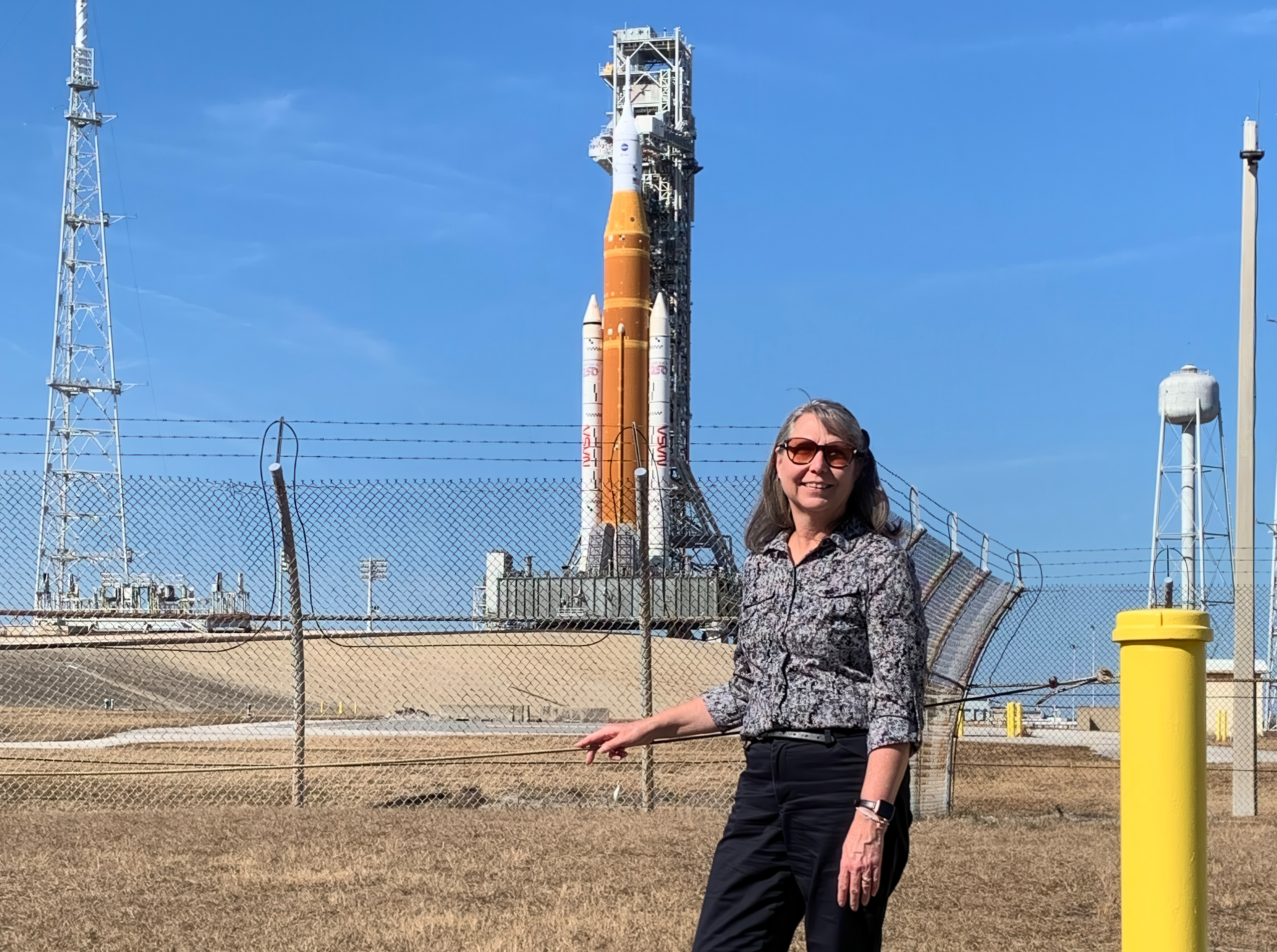
When the historic Artemis II mission launched in April 2026, many of us watched from Earth, eagerly following the crew’s journey through daily updates from space. Behind the scenes, Florida Epsilon Sharlene Wendel Martin was an integral part of the team responsible for bringing the astronauts home safely. Learn more about the career path that led her to play a role in one of the most memorable achievements of her lifetime—and in human history.
Tell us more about your career today.
I work as a project engineer in Lockheed Martin’s Orion Program Management Office, supporting NASA’s Artemis program and its mission to return humans to the Moon for the first time in more than 50 years. I manage NASA-directed change requests, coordinating with engineering and financial teams to help implement mission-critical updates that support the future of lunar exploration.
What inspired you to pursue a career in the space industry?
Growing up in South Florida during the 1960s and 1970s, the excitement of the Apollo era was part of my childhood. For each launch, people in our neighborhood would go outside to watch— some would even climb onto their roofs to get a better view. When I completed my military service in 1990, the space program was ramping back up with the early planning for the Space Station. I was fortunate enough to be part of the initial U.S. Space Station planning, called Space Station Freedom at the time. When this program transitioned to the International Space Station, I transferred to the Space Shuttle program, where I worked in payload processing. Experiencing a Space Shuttle launch onsite at Cape Canaveral is when I knew I wanted to be part of the excitement of human spaceflight.
What challenges do you face in your career and how do you overcome them?
With the recent rocket launch failures in the news, you may have heard people say, “Spaceflight is unforgiving.” Human spaceflight is even more challenging because the lives of the astronauts are in the hands of the Artemis teams. Everyone on the team—no matter their role—must work together, stay on schedule and remember the goal is to return the astronauts home safely to their families. Trusting my teammates is how I overcome those challenges.
You contributed to the historic Artemis II mission. What was your favorite part about working on this project?
The excitement of launch day, watching the powerful Space Launch System rocket take off from the launch pad. Watching mission briefings every day and seeing the beautiful pictures the astronauts were sending back to Earth. And, most breathtaking of all, watching the fiery re-entry and splashdown and seeing the astronauts come out of the crew module, knowing they were safely back on Earth! The combination of excitement, relief and pride made the years of hard work worth it.
What keeps you motivated in moments of stress or burnout?
The team. Being there for my teammates to help them succeed is what keeps me going during times of stress. Every time we work together to overcome an obstacle, it reminds me that we can accomplish big things by succeeding in all the small steps along the way.
What advice would you give to sisters pursuing a similar career?
Pursue an engineering degree at your college or university; an engineering degree opens the door to so many possibilities. Engineering teaches problem-solving skills, which are among the most important skills for overcoming the challenges in the growing and expanding space industry. The second most important skill is working with a team. Take on group projects or join a local student engineering organization.
What’s something Pi Phi instilled in you that you continue to lean on today?
During college, Pi Phi instilled in me a sense of confidence and the desire to explore new opportunities. Working alongside my sisters taught me the importance of teamwork, a lesson I still rely on today. During my last year of college, I was fortunate to be elected Chapter President, and that role helped me build leadership and communication skills that are integral to my career.